| Beate
Ermacora
Approaching dot-communities
(translated
into English by Katherine Houghton)
With her installation dot-communities, specially conceived for
this exhibit in Mülheim, Birgit Jensen opens a new chapter on the topic
of urban landscape, which she has continually developed and evolved
since the end of the 1990s.
When we think of the term city, we no longer have an image in our
minds of a man-ageable city with a clearly defined center and towering,
distinctive
church spires. The image is also not one of the European metropolis
of the 1920s, romanticized by art-ists and writers. Imbedded in our
imaginations instead are those cities that have posi-tioned themselves
for the most part through the media: the contemporary megacities
with their jungle-like structures and their multiple centers. They
not only
seem to re-semble each other around the world in their organic and
chaotic sprawl, but also in their shared signifiers: the skyscrapers,
mobile phone masts and the omnipresent labels of global advertising.
In this light the term urbanity has become increasingly conflicting,
where fascination with the big city and the opportunities available
only there sometimes becomes associated with the uncomfortable, or
even the threaten-ing. Today’s city has radically distanced itself
in every regard from the renaissance concept of ideal city planning
or the utopian planning of the Modern. While Friedrich Schiller described
the city as a site of rationality in his elegy Der Spaziergang (The
Walk) from 1795, today’s large cities have not only become an
unmanageable ter-rain, but also a habitat where human existence can
hardly be conceived of at all.
Fundamental questions concerning social sensibilities, needs and
possibilities as well as their communicative qualities in dense urban
areas were
the focus of an increas-ing number of artists in the previous decade.
Birgit Jensen also takes on such ques-tions in her paintings in order
to explore the structure and essence of cities. In this process she
takes a distanced perspective. The emerging metropolises of the Mod-ern
are often referred to in the context of Jensen’s work, those
cities, which became legends or even symbols of a new lifestyle and
were captured by numerous artists in film, photography and painting.
While these artists tell us of their desire to experience things first
hand and one is reminded of Walter Benjamin’s description of
the flaneur, whose perspective is molded by the urban dynamic, who
observes the circumstantial and the spontaneous and captures images
of everyday life, the viewer is not a direct participant in Birgit
Jensen’s works. First of all, the viewer is assigned a perspective
from aloft, allowing him to be everywhere and nowhere at the same time
and sec-ondly, people are not present in the paintings. Instead her
works pose questions sur-rounding the perception of images alongside
the experience of contemporary urban-ity.
Jensen’s urban landscapes make up an independent complex of works
in her oeu-vre, incorporating different elements already developed
in previous works. Birgit Jen-sen is a painter, but she views and practices
the art of painting from a conceptual standpoint. Many of her visual
concepts resemble analyses, in which she juxtaposes colors and definitions
and experiments with tables and diagrams, pictograms and symbolic codes.
She normally begins with the simplest geometric and graphic ele-ments
like dots or vertical and horizontal lines and intertwines them in
such a way that they form an ornamental pattern. Even the intentional
sleight of hand through optical magnification is part of her artistic
strategy. However abstract these works might appear, they are always
anchored in the reality of different contexts, preferably those outside
art, and are created through a complex process. Photos are digitalized,
modified, layered together and placed on canvas by silkscreen. It is
precisely the use of reproduction techniques that allows Jensen to
concertedly reflect on painting and the qualities of form and color.
It is not a coincidence that the raster images also re-mind us of the
resolution of digital photography and computer-generated imagery. Her
works fathom not only visual stimuli and effects like proximity and
distance, space and surface, abstraction and concreteness, but also
take on the new media as their theme and employ their visual characteristics,
which enable us to read and in-terpret reality.
In her Moiré series of paintings, with their abstract patterns
reminding us of Op-Art and preceding the urban landscapes, it is already
apparent how Jensen handles the interaction between color spaces of
different densities and variations between light and dark. She incorporates
these experiences in her contemplation of the depictabil-ity of contemporary
urban areas, taking particular interest in their public images and
clichés. Although her works use certain cities like Los Angeles
as their starting points, it is clear that her intention is not an
exact architectural rendition. She is more con-cerned with capturing
a feeling or an atmospheric mood as in Piet Mondrian’s New York
paintings. In his later work he used an architectural metaphor, in
which concrete structures of color and form layer, alongside impressions
of skyscrapers, street net-works and the hectic rhythm of Manhattan.
If one stands directly in front of Jensen’s large format paintings,
one sees rectangles of varying sizes referencing geometric architectural
forms, arranged in apparently random formations on a dark background.
Only at a greater distance can the image be deciphered and the viewer
made aware that the pixelled dots, rasters and clusters stand in meaningful
relation to each other and enable street networks, bridges and buildings
to take shape. As if projected from the painting’s surface they
take on a plastic, three-dimensional form and describe the endless
space of a megacity, continuing beyond the edge of the canvas, whose
hori-zon only begins to be suggested in the vast distance.
In the course of her work, Birgit Jensen has moved further and further
away from creating recognizable cityscapes, using multiple photos
of different cities at the same time in an individual painting instead.
This layering technique allows imaginary and expansive structural
patterns
to emerge. Particularly distinctive details are often re-peated in
several paintings. Our visual memory is put to the test with mirror
images and different hues, while challenging us at the same time
with the issue of urban uni-formity. Although one can still associate
the
views of Los Angeles with a flickering sea of lights as seen from
above by night, this association is no longer possible in more recent
works.
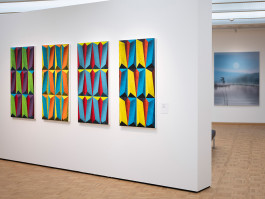
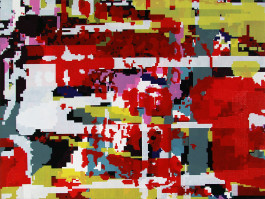
Pale backgrounds are covered with black, brick red or pastel structural
patterns that are out of focus, blurry, even spectral, emerging out
of the painting’s fundus and appearing to float. Although Jensen
uses images of illuminated cities by night again here, these serve
merely as simple color reverse processes. What we see in the paintings
is light, reflected out of windows and from moving vehi-cles, emitted
from lighted billboards and enormous digital advertising displays.
It is not earthly, material substance, but instead the dynamic of light
that describes the energetic potential of life in a large city. To
further increase the dynamic of the cap-tured image and to do justice
to the notion of vibrant cities, pulsing with energy, vis-ual details
are repeated, layered and duplicated. Blurs and abrupt circular motions
ensue, creating new and unusual spatial perspectives and linking individual
elements in the paintings.
Recently the artist has begun to cross over into the proverbial jungle
of symbols and information on offer in the city and to zoom in more
closely on these details. The re-sult is a group of paintings in
which typographies reminding us of flashing billboards shout out
at us and
demand our attention just as they would in any metropolis. Text fragments
and overlapping pictograms prompt a series of new associations.
dot-communities, the object created for the Kunstmuseum Mülheim
an der Ruhr, giv-ing the exhibit its name and providing the pivotal
element for the design of the instal-lation, could be a highly enlarged
and substantiated fragment of one of the paintings. In planning the
room-filling 4.55 x 9.6 meter installation, the artist used the idea
of an enormous billboard in a public space as her starting point. As
a painterly detail one would probably have to look for the motif with
a magnifying glass. Standing alone as an object in space, it baffles
us with its physical presence. Jensen’s always challeng-ing play
on dimensions, visual and spatial experiences is presented here in
a com-pletely new format. dot-communities is a radical and complex
work, in which Jensen uses digital printing techniques for the first
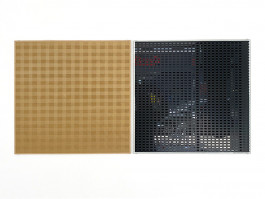
time in her oeuvre. The enormous bill-board shows a surging sea of
voluminous red, blue and green dots surrounding an irregularly formed
white space. White flashes from those areas where the dots’ col-ors
cancel each other out at their intersections. In contrast to the urban
landscapes where Jensen upholds representational legibility despite
the high degree of abstrac-tion, the viewer of dot-communities has
to take a different approach to the work. If we take the title literally,
it describes what we are actually seeing: a community of dots. The
artist assumes, however, that the viewer is learned and intuitive.
That the viewer will take pleasure in being led away from a quick and
compelling observation of color-ful dots and through the theory of
colors in order to comprehend how print and screen colors are defined
and how digital image processing actually functions. Above all, the
title refers to the “dotcoms“, those companies of the new
economy that have influenced so many different aspects of everyday
commerce and have brought about so many societal changes. Out of the
abbreviation “.com“, which stands for “commercial“,
Jensen derives the word “communities”, obvious in the context
of her explora-tions of the city.
Birgit Jensen’s definition of the city brings together all the
possible theories and discourses on the subject and myth of the city.
Taking a current appraisal into account she subtly refers to and incorporates
the reality of the omnipresent internet in her work and attempts to
create and describe a virtual space with sensual, tactile means. Looking
beyond the stimulating effects the work evokes on the canvas concerning
light, it addresses the depiction of something ephemeral, something
that is only pre-sent for a short time, making space for a new reality
as it disappears. The urban living environment, according to Jensen’s
interpretation, is something, in which subcultures and parallel societies
form, pop up here and there for a brief moment, disappear and turn
up somewhere else anew. Through the layering of subject matter and
color the artist succeeds in depicting the realities behind the reality,
sending us on a perceptual journey of discovery. Hidden behind the
detailed precision of the painterly surface of the large billboard
dot-communities is a statement running contrary to the advertising
slogan of a real billboard. The photo which served as the basis for
the work, in turn, shows a lighted billboard on the roof of a house.
Its content has vapor-ized into the glowingly white surface of the
artwork. In this sense the dots not only stand for graphic raster dots
but also for conceptual intersections at which different levels of
meaning meet.
Andreas F. Beitin:
Earthly Galaxies
or: Stratigraphy of the Third and Fourth Dimension
On
Birgit Jensen’s
Cityscapes
|